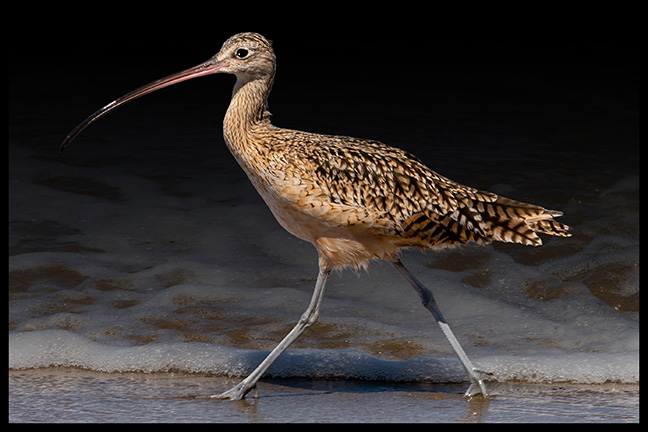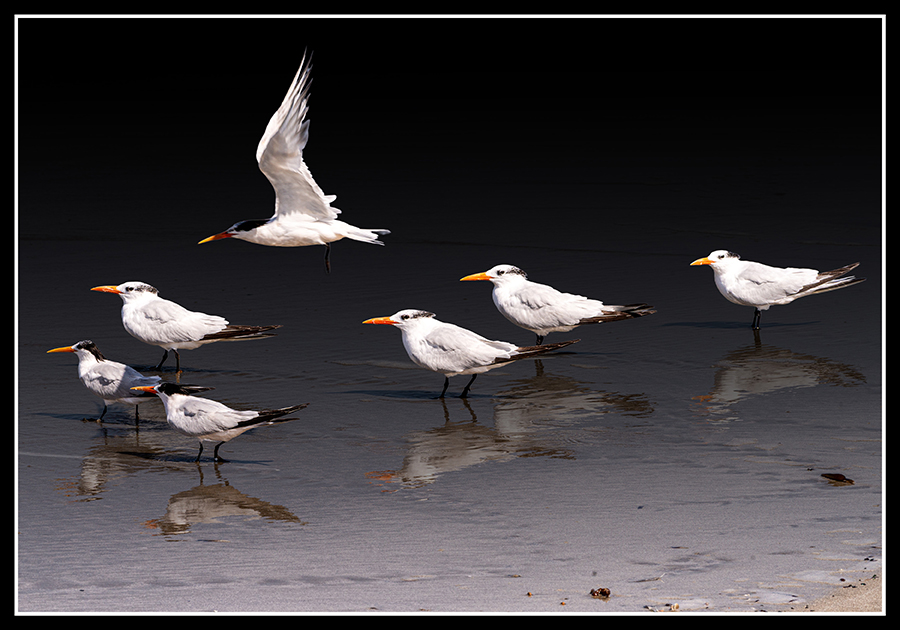
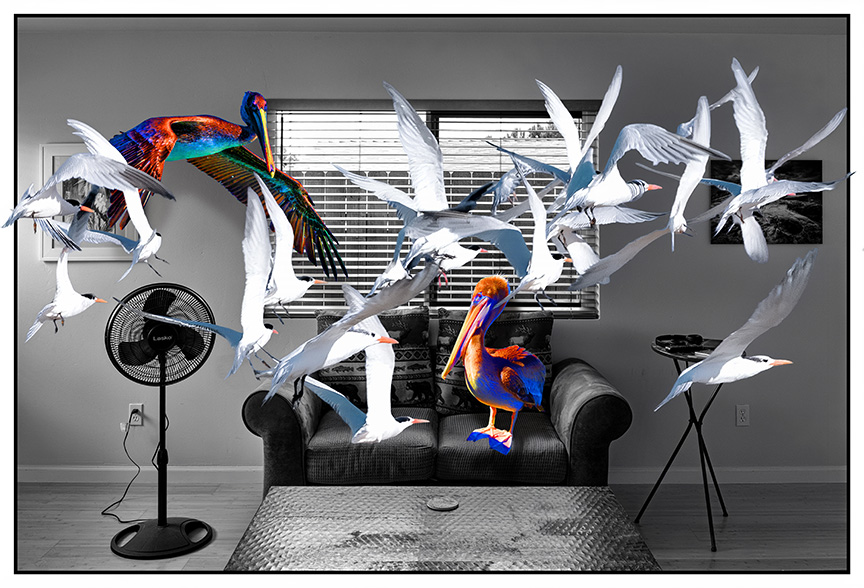
A week or so ago, I was taking a group of framed photos to the Seven Sisters, my gallery home in Morro Bay. When Patty (the friendly proprietor) looked at Attention Span I, my photo of terns rendered with the “dark curtain” effect I was recently experimenting with, she commented that she could price it as an art print — in contrast to some other animal photos I brought which were different only in that they didn’t employ the curtain thingy, and would presumably be considered more decor.
Pondering this odd distinction kicked off, for me, a long breadcrumb path of internal monologue regarding this whole thing called art: if the difference between it and a dining room knickknack can come down to a measly Photoshop filter, what conclusion can we draw? At the end of the day, what is art, really? How you know it when you see it? And why is it worth all the fuss we’ve made over it since, I dunno, antiquity?
I can say with reasonable confidence that I know a thing or two, or even a half dozen, about art. My Master’s degree from UVa is in Art History; and it likely would’ve been a PhD if my life hadn’t blown up (the first time) around then. Since then, all the way up to today, I’ve probably devoted more of my thought and reading and museum visiting to art than just about anything else.
And while a Master’s in Art History plus $6 will get you a venti mocha at Starbucks and not a lot more, it does give me some insight into the nature of art. Or so you would think.
Up until late in the 19th century, everybody pretty much knew what art was when they saw it: naturalistically-rendered pictures or sculptures of people and animals doing things that your Aunt Millicent would approve of. (Okay, not that odalisque that Uncle Uriah hung in his study, but he kept that out of sight behind the etagere.)
Maybe the first tremor to rattle this generally-held conception was the advent of photography. If a camera could actually make a more accurate rendering of nature than the most skilled painter, why couldn’t you just grab a daguerrotype, get four guys to dress up in togas and swords, and do a better Oath of the Horatii than that overwrought thing by Jacques-Louis David? And if so, was a photograph therefore classifiable as art, even though the camera did all the work?
Of course, in the 19th century, film didn’t yet have color. But neither did Jacques-Louis David, really.
Anyway, the real body blows to traditional notions of art started coming in earnest toward the end of the century with the Impressionists. What was up with all those flat speckles of paint? How could you define form without actual drawing? My kid could spatter oil paint on a canvas too, y’know!
That was nothing, though, compared to the shocks that came after the turn of the 20th century: the fauves (“wild beasts”), with their bizarre, unnatural color and weirder space; Picasso and the cubists, blowing up form into it’s constituent parts; Dali and melting watches; Matisse’s cutouts, like the products of a fourth grade Sunday school class with scissors and a ream of copier paper. (Settle down, settle down, I love Matisse.) Symbolism. Futurism. The Blue Rider. Dada.
Finally, the biggest earthquake of all: full abstraction. Kandinsky. Mondrian. Pollock. My kid could spatter oil paint on a canvas too, y’know! How could you evaluate art — how could you even tell if it was art — if you couldn’t even make out what the subject was?
Fast forward to the chaos of today(ish) museum-grade art: giant-scale party balloon dogs (Jeff Koons); an extremely messy bed (Tracy Emin); a decomposing shark corpse (Damien Hirst); a self-shredding graffito (Banksy); a banana famously taped to a wall (Maurizio Cattelan).
What’s the common denominator that holds all this stuff together under the single rubric art?
This is the elephant in the room when it comes to the fine arts — painting, sculpture, photography, film, etc. — and it hasn’t really ever gone away. We all talk about art like we know exactly what we mean. But what, precisely, is it? If you held Botticelli’s Primavera [below] in your left hand — careful, it’s heavy — and you sucked out whatever makes it art and held that in your right hand, what would it look like?
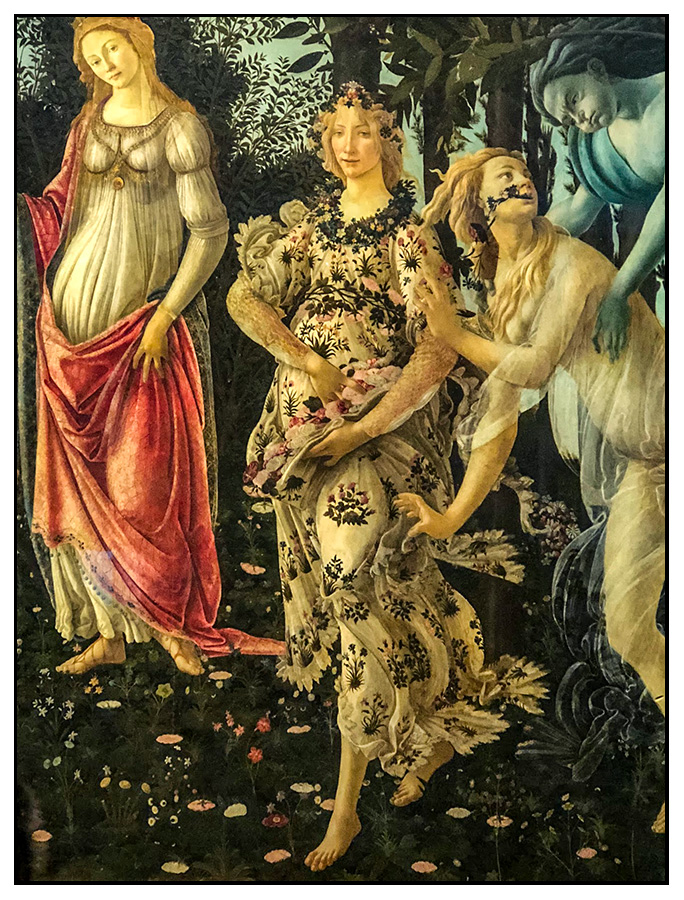
Botticelli’s Primavera, detail. Don’t drop it!
Back when I was a young and arrogant Art History undergrad (some things never change), after reading an essay entitled What is Art? by the revered art historian Horst Janson, I wrote an essay in rebuttal that fortunately no one ever saw. In my piece, I argued that the question is entirely irrelevant: “art” is whatever its creator chooses to label as such. The only relevant questions are whether the piece is accomplished (whether it skillfully achieves its own aims) and whether it is effective (whether it persuades anyone to want it).
Oddly enough, about 50 years on, I don’t necessarily disagree with that cocksure young man’s analysis. But I still don’t find it very satisfying. It’s kind of like saying you can call your Corolla a Ferrari, as long as it’s yellow and it gets you from A to B. I mean, you can, but you might find the resale market disappointing.
There’s obviously something tangible that makes a Ferrari an aspirational purchase pretty much universally (among males, at least) — whereas a Corolla, not so much. Likewise, there’s a reason that given a choice between hanging Titian’s Ecce Homo or a still-wet velvet Elvis off the Ocean City boardwalk, at least 9 out of 10 museums are going to roll with the Titian. For some reason, the more generations of people have learned about and experienced art, the more they have tended to gravitate toward particular artists and artworks — some intrinsic quality that we can define in a meaningful way.
After thinking about the question for a long, long time, I believe I’m ready to venture a bit less callow response to the question of What is Art?
And I’ll be tackling that one… next time.
Some other stuff I’ve been up to
If you’ve looked around the site a few times, you may have noticed that I’m always adding new stuff and, from time to time, formatting things in new ways. This past couple weeks, I have added a new Black and White portfolio; added some new surfing photos to both the Black and White and Surfers portfolios; and added a new Virtual Gallery Show, called Salon.
With regard to the last, don’t be fooled by the rather static and harmless-looking intro photo to Salon; it’s simply the start of a pretty wild ride.
Salon VII
So enjoy the pretty pictures and I’ll see you next time. Be there or be square.