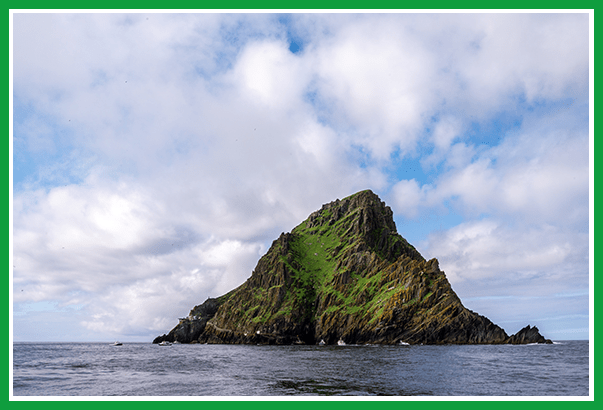
Welcome, pilgrims!
Skellig Michael (Sceilig Mhichil) is a tiny rock spire of an island, lying off the Kerry coast of Ireland. Somewhere between the 6th and the 8th Century, early Christian monks established a primitive monastery there, carving it by hand into the sandstone and slate bones of the island. It is one of only two UNESCO World Heritage sites in Ireland.
To call the place “desolate” would be an understatement. A full twelve kilometers off the coast — an hour by powerboat and heaven knows how long by oared coracle against the hostile sea — Skellig Michael boasts neither a supply of fresh water nor any arable ground to speak of. It does not support livestock. Most foodstuffs had to be brought from the mainland, which meant the monks here faced near-starvation during the stormy winters when sailing was almost impossible. Water supplies were restricted to what could be captured from the skies. Only about a dozen brothers and an abbot could survive on the island at a time.
The End of the World
(as they knew it)
Some historians say the monks went there to escape turmoil and invasion by Northmen on the mainland. Others say it was the brothers’ attempt to emulate the privations of desert ascetics in the Christian middle east. The lack of even the homeliest comforts, the foul weather, and dangers on every hand must have made for a miserable existence. For the men on this island it was, quite literally, the end of the world.
And yet. The tiny monastery, with its sturdy stone buildings and retaining walls, along with no fewer than three stone stairways that ascend from the waterline to the settlement, bespeak remarkable enterprise and resilience. (The stair used today by visitors, by itself, is constructed of 618 rugged stone steps.) Founded according to legend by Saint Fionan, the monastic community survived here for hundreds of years until steadily worsening winters — climate change, ironically — forced its relocation to the village of Ballinskelligs on the mainland in Kerry.

Skellig Michael is the northernmost of a string of Christian monasteries dedicated to the Archangel, stretching in an astonishingly straight line through France (Mont Saint-Michel), Italy, and Greece to the Middle East. Called “Saint Michael’s Line,” it marks according to legend the groove that was cut by the heavenly soldier’s blow when he sent the devil crashing down to Hell. The Line has been described elsewhere in detail, in case you’d like to hear more about it. (The august and unimpeachable Wikipedia labels discussion of Saint Michael’s Line as pseudoscience — precisely as one might expect from the world’s leading purveyor of humbug.)
I first heard of the island about forty years ago, when I read Kenneth Clark’s book, Civilisation, as a first year grad student in Art History. I quickly forgot everything else in the book, but Clark’s description of Skellig Michael stayed with me; I’ve wanted to visit it ever since.
An obscure place for the great majority of its existence, the island monastery suddenly experienced its fifteen minutes of fame when it became a movie set — as Luke Skywalker’s middle-age hermitage in two Star Wars films, The Force Awakens and The Last Jedi. (The trailer for the latter includes some footage from Skellig Michael.) Until that time, it was relatively easy to book passage from Portmagee, the closest mainland port, out to the island. Now — given that UNESCO limits visitation to 180 people per day, and that only during the summer season — film fans provide fierce competition for the few visitor slots. Even though Carol and I looked into booking many weeks in advance, there was no availability.
And then, when she looked again while we were staying in Kerry, slots had opened up for a sailing on the very next day. Whether Luck of the Irish or an old-fashioned miracle, we snapped them up immediately.
Skellig Michael did not disappoint.
For more views of the island and the monastery, check out our gallery.



 Ronald Crittenden